
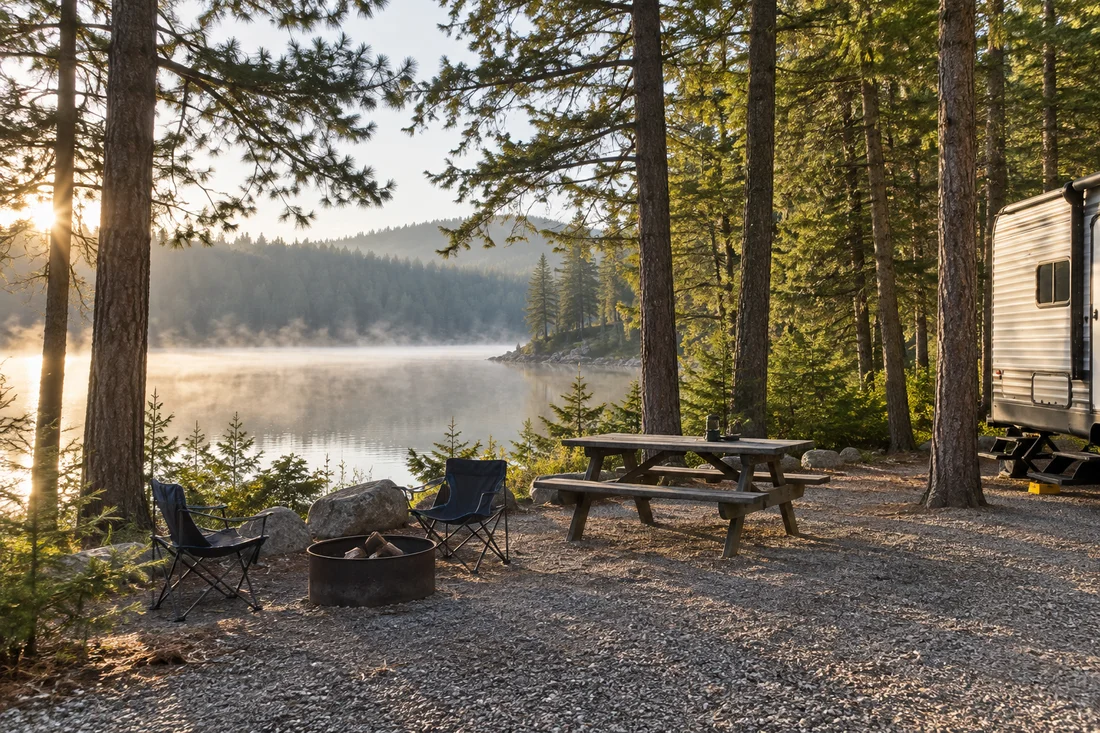
“RVs welcome” is the beginning of campsite research. It does not establish that your specific rig, tow vehicle, slide-outs, and equipment fit a particular space. A better reservation process separates the campground’s general facilities from the individual site and the route used to reach it. Resolve the essentials before paying, and keep a written record of any clarification that changes your decision.
Make a vehicle reference card
Record the vehicle’s actual length, width, and travel height using an appropriate measurement method. Include rooftop equipment and the configuration in which you will arrive. For a trailer, record the trailer and tow vehicle separately as well as the combined travel arrangement. Site descriptions may use different definitions, so ask what a limit means when it is unclear.
Add the space required for slide-outs or other approved camping equipment, the electrical service you need, and any accessibility requirements. Keep these facts available while searching. A memory of the sales brochure is less useful than a reference card for the vehicle you actually own or rent.
Read the individual site
Look for equipment limits, driveway dimensions, surface, slope information, back-in or pull-through configuration, and photographs tied to the actual site. The National Park Service notes that RV campsite arrangements vary and that slide-outs can create space questions. Treat photos as supporting evidence rather than proof of clearances that are not documented. NPS site selection guidance.
Ask whether the tow vehicle can remain at the site and what alternative parking requires. Confirm that any essential amenity applies to your selected site. A campground may have a dump station without providing a sewer connection at every pad; a list of general services cannot settle the individual arrangement.
Check the approach and the rules
Review official access directions and restrictions for the campground. A navigation app’s shortest route may not be appropriate for your dimensions or configuration. Research the route independently using authoritative vehicle and road information. This magazine does not certify a route as safe for every RV.
Read arrival procedures, check-in times, occupancy rules, pet policies, quiet hours, equipment restrictions, and cancellation conditions. Recreation.gov states that policies on individual location pages can supersede its general rules. Save the specific booking terms you accept. Reservation policy guidance.
Ask questions that can be answered
Instead of “Are you big-rig friendly?”, give the operator your dimensions and the exact site number. Ask which length is measured, where the tow vehicle parks, and whether there is a known access issue for that arrangement. For accessibility needs, ask about the actual facilities and routes you need rather than relying on a broad label.
If information is missing, mark it unknown. Do not turn an unmentioned shower, service rating, or pet policy into a confident yes or no. Choose a different site when an unresolved detail is essential to the stay. After booking, save the confirmation and relevant contact information offline. For a real destination example, see our Big Meadows guide, where the absence of hookups changes the preparation even though RV camping is permitted.